
The Commission has committed to agree a high-seas allocation framework in 2027, for a stock whose distribution is projected to keep shifting for the rest of the century. The framework has to still be defensible on the days the projection turns out to be wrong.
The Western and Central Pacific is the largest tuna fishery on earth. Inside national zones, access is licensed and the arrangements are mature. Outside them, on the high seas, catch and effort limits exist but they divide between nobody: CMM 2025-02 records that the high-seas limits in its Attachment 1 do not confer the allocation of rights to any CCM.
The Commission has now committed to fix that. It will commence a process to develop that framework in 2026, to enable the Commission to reach agreement in 2027 on hard effort or catch limits in the high seas of the Convention Area and a framework for the allocation of those limits in the high seas amongst all Members and Participating Territories.
So the decision is not how many fish. It is on what basis the share is computed. That is decided once, by consensus, and then lived inside for a very long time.
Roughly eighteen months to design an allocation framework for the largest tuna fishery on earth, for a stock that is physically moving.
CMM 2025-02, which runs to 15 February 2028Think about one season. The warm pool sits further east than it did, the skipjack are with it, and the purse-seine fleet follows. Days that would have been fished in one zone are fished in another, or beyond every zone. The catch is landed, the returns are filed, and the numbers go into the record as fact.
They are facts. What they are not is an answer to the only question that matters for a framework: was that the oscillation, or the trend? El Niño and La Niña move this stock a long way, in both directions, on a few-year rhythm. A slower redistribution is projected to run underneath. In any single year the two are added together and only their sum is observed. Nobody standing in the room in 2027 can see which of the two produced the last five years of data, because that separation is not in the data. It is an inference, and it comes with uncertainty attached.
Which means a history-based rule is not the neutral, evidence-led choice it appears to be. Averaging the last five years bakes in wherever the oscillation happened to be. Averaging the last fifteen smooths that out and lags the trend instead. Both are defensible. Both are auditable. Both are what a careful person would propose. And on the day the number has to be adopted they do not give the same answer.
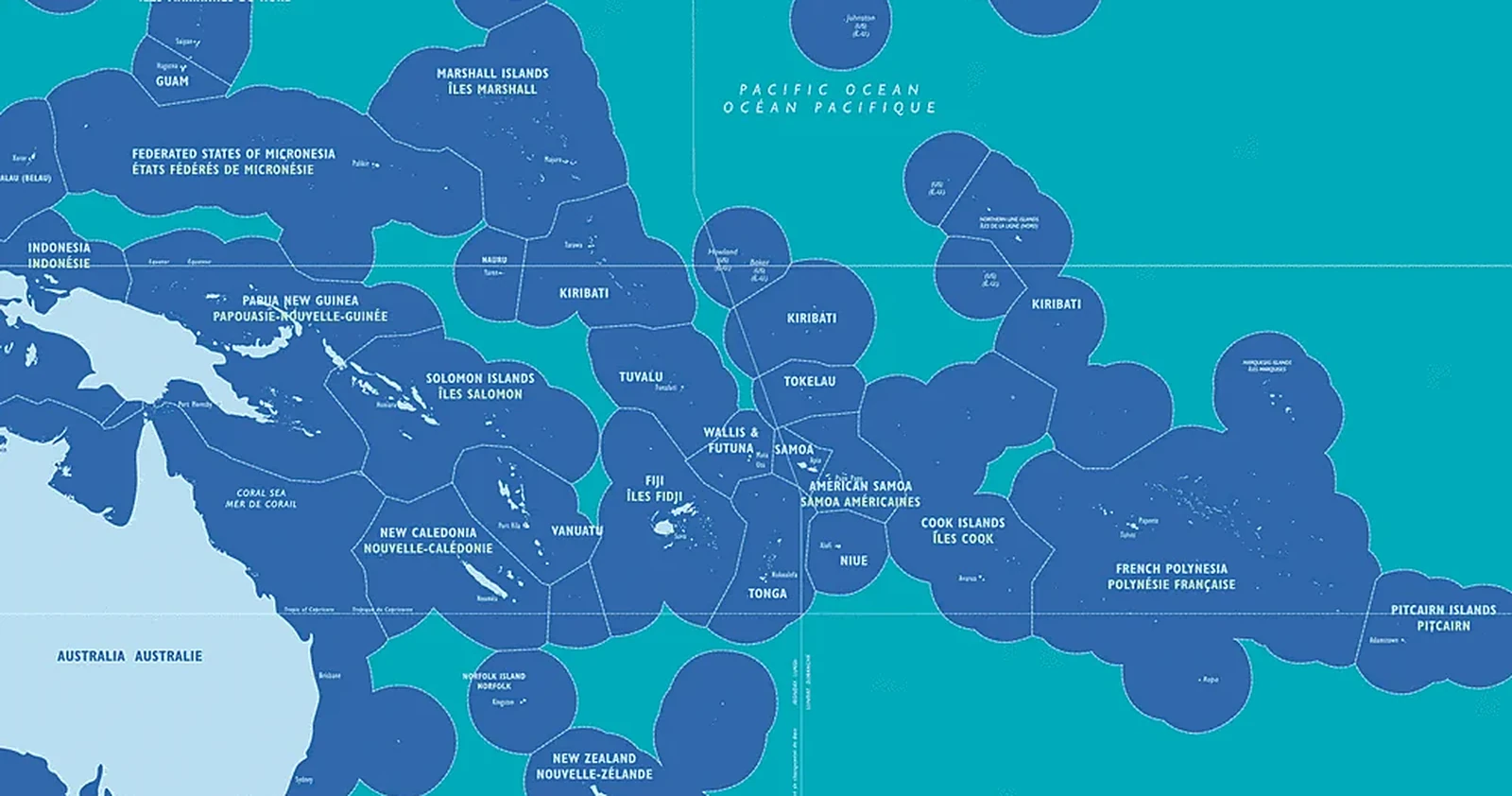
Meanwhile the boundary does not move at all. An exclusive economic zone is a line fixed in law, drawn to a coastline. Everything biological about this problem is in motion and the one thing dividing it is not.
The commitment is in the measure, not in commentary about it. CMM 2025-02, the conservation and management measure for bigeye, yellowfin and skipjack tuna in the WCPO, commits the Commission to begin the process in 2026 and to reach agreement in 2027 on high-seas limits and on a framework for allocating them. The measure itself runs to 15 February 2028.
Updated projections for WCPFC tuna stocks are being presented in Apia on 10 August 2026, ahead of the Scientific Committee’s twenty-second regular session (11–19 August). They move from a CMIP5 to a CMIP6 climate ensemble and from two-degree to one-degree spatial resolution, prepared, in SPC’s own words, through financial support from the New Zealand Government.
The evidence base for the 2027 argument arrives about sixteen months before the argument has to conclude.
That second clock is the one worth dwelling on, because it decides what the first one produces. A framework agreed by negotiation alone will draw on that science as argument. A framework with a computable, reproducible basis converts it into the instrument itself.
A Commission can only adopt a number that every Member can recompute and check.
The incumbent is a historical rule: divide on where the fish were, and who caught them, averaged over the last N years. It deserves setting out at full strength. Every Member can compute it from data everyone already holds, it cannot be gamed by a model nobody outside the room understands, and it has long precedent. It also works. Forum Fisheries Agency members reached a zone-based allocation framework for South Pacific albacore in July 2025, and the Commission adopted a South Pacific Albacore Management Procedure at its twenty-second session in December 2025. That is the standard to beat, and a real one.
Its weakness is not accuracy. It is that it is stationary and the thing it divides is not. A rule fitted to a distribution assumes the distribution stays put, and the entire premise of the 2027 process is that this one will not. Worse, the choice of window, whether five years or ten or fifteen, is itself an allocation decision wearing the clothes of a methodological one. It is made by people who cannot know, at the time, where in the oscillation they are standing.
So the test for a forecast here is not the usual one. It is not is the projection accurate. Projections of this stock to 2050 carry wide uncertainty and everyone in the room knows it. The test is:
Does the allocation stay defensible on the runs where the forecast is wrong?
the only bar worth setting for a decision under deep uncertaintyThat is a different discipline from stock assessment and ocean modelling. It is robust optimisation, constraint programming and risk-bounded policy design: choosing the rule that performs acceptably across the whole ensemble of futures rather than optimally against the central one. On our reading, that is the seat the 2027 process is about to require. That reading is an assessment, not a verified fact, and we offer it for correction.
One more thing the incumbent has going for it, worth saying out loud rather than hiding: there is no crisis in the present data. High-seas catches were approximately 12% of the WCPFC Convention Area total in 2024, a sharp decrease from the 2023 total of 17%, and well below the levels seen during the period 1990–2007 when high seas catches accounted for at least 25% of the annual total.
The 2024 total catch was a record 3,059,005 tonnes. Anyone arguing that the high seas is emptying the zones right now is arguing against the Commission’s own overview. The case for building the instrument in 2027 is not that it is urgent today. It is that it can still be designed calmly, before it is contested.
The grey line is what gets observed each year: a slow redistribution and a large oscillation, added together, with only the sum visible. Over it are two history-based rules that any careful delegation might propose: a five-year trailing average and a fifteen-year one. Neither is wrong. Neither is arbitrary. They simply carry different assumptions about which part of the signal is real, and on the day the number has to be adopted they are more than three percentage points apart. That gap is not a modelling error. It is the decision, hiding inside a methodological choice. Underneath sits what is actually measured.
The upper series is schematic: it illustrates a well-documented structure, interannual oscillation larger than the decadal trend, and is not a fitted series, a stock assessment or a projection. The high-seas shares underneath are measured, and are quoted from the Commission’s own 2024 overview.
Estimate the slow redistribution underneath the interannual signal, and carry the uncertainty in that separation forward into the allocation rather than averaging it away. The output is not a point forecast of where the fish will be. It is a distribution over futures, which is the only honest input to a rule that has to hold across all of them.
Choose the allocation rule that performs acceptably across the whole ensemble, including the members of it where the central projection is wrong, rather than the rule that is optimal against the central projection alone. This is a constraint-programming and robust-optimisation problem, and a different specialism from population assessment.
Shares that can be published years ahead with the adjustment rule stated in advance, so a Member can plan against them, and so a change is the rule operating as designed rather than a renegotiation. A framework nobody can plan around gets reopened, and reopening is where the cost is.
Say in advance, and show why, when conservation limits, equity provisions and existing entitlements are jointly infeasible, rather than discovering it in the room at three in the morning. Infeasibility detection is a standard output of a constraint model and an unusual one in a negotiation.
Every input public, every step recomputable by any Member from those inputs, and the method back-tested against the historical record: what would this rule have produced through the last three decades, including the strong El Niño years. A number that cannot be checked cannot be adopted, whatever its merits.
That the high-seas share is currently growing. It is not. It was approximately 12% of the 2024 catch, down from 17% in 2023, and both sit well below the 1990–2007 period when the share was at least 25%. The redistribution at issue is a projection to mid-century, not a present trend, and this page does not dress one up as the other.
Any Member’s position on allocation. Nothing here states, characterises or infers where any Member, Participating Territory or group stands.
That allocation is a matter for the Scientific Committee. It is not. Under the Convention the Commission determines total allowable catch and develops allocation criteria; the Scientific Committee’s role is to review assessments and report its findings and recommendations to the Commission. Any decision framework is an input to a Commission process, through whatever route Members choose.
A candidate allocation framework can be back-tested against three decades of record, including the strong El Niño years, using only the data that existed at each point. What it would have produced is knowable before anyone has to agree to it.