
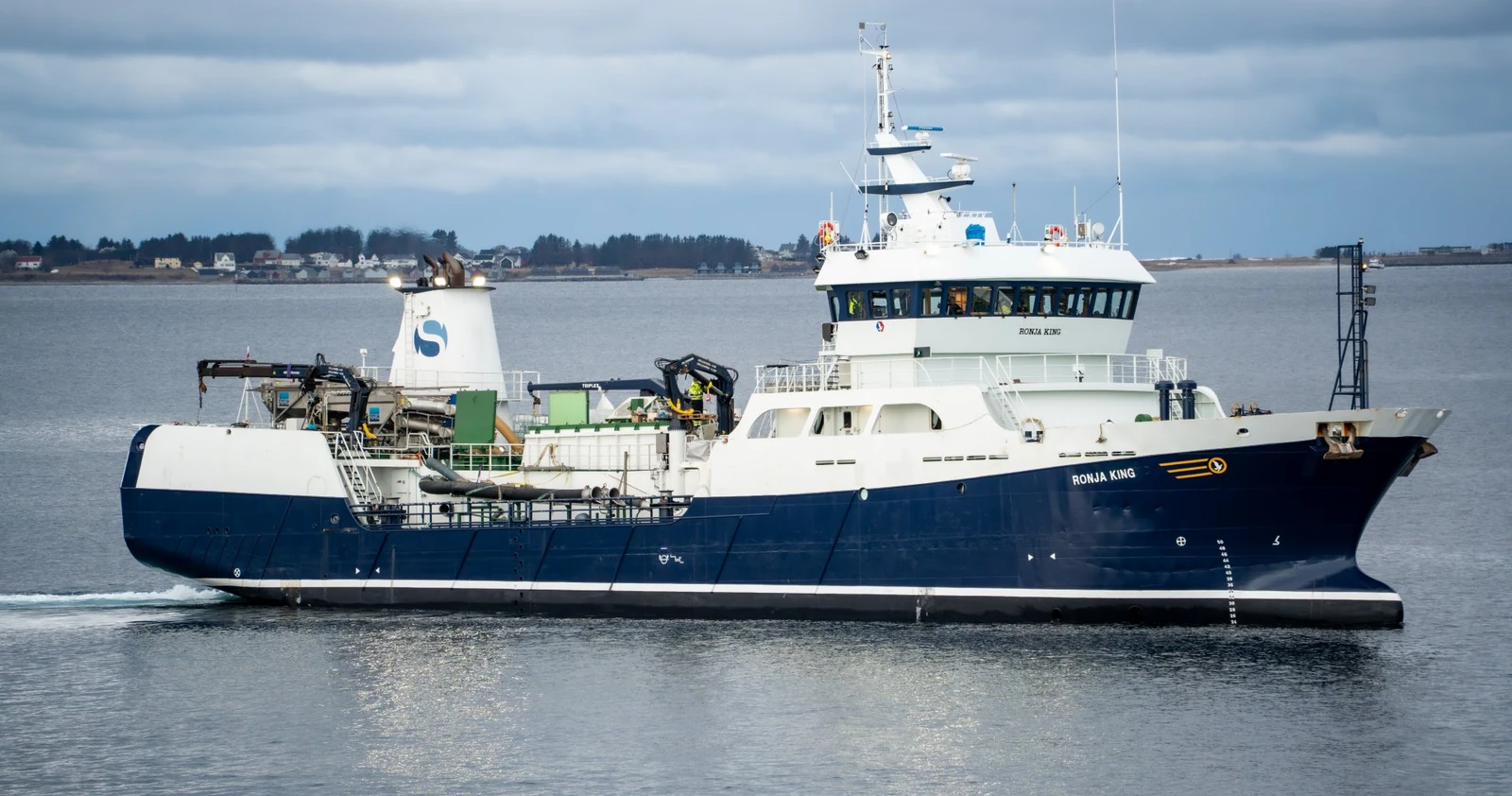
New Zealand’s first wellboat arrived in April and was working by late May. It costs about $8.9 million a year and it can be in one place at a time. Which place, and when, is now a decision somebody has to make every week of the warm months.
For most of its history the New Zealand salmon industry did not have this decision, because it did not have the means to act on it. Fish were where they were. Moving them meant towing pens, slowly, when the weather allowed.
That changed this year. New Zealand King Salmon leased the Ronja King from Norwegian operator Sølvtrans on an eight-year term at approximately $8.9 million a year, shareholders approved it in February, and the vessel was operational from late May. In the company’s own description it is used for relocating fish between farm sites, stock grading operations, and early removal of underperforming fish.
Until it arrived, New Zealand was, on NZKS’s account, the only major salmon-producing country not using this technology.
So there is now exactly one of these in the country, against eleven consented sites: eight in the Marlborough Sounds, three of them currently fallow, plus Blue Endeavour in Cook Strait. Every week of a warm summer, someone decides where it goes. That decision is worth roughly $170,000 a week in lease alone, before anyone counts the fish.
A capability you did not have is not a decision. A capability you have one of, is.
what changed in MayChinook are a cold-water fish in water that is getting warmer. Sanford, farming at the other end of the country, states the threshold plainly: Salmon are a cold-water breed and begin to die of stress at around 20° Celsius
, in a bay that averages 14°C. A degree and a half of marine heatwave is the difference between a normal February and a catastrophic one.
What that looks like in a pen is nothing, for a while. Appetite drops first. NZKS attributes lost growth to suppressed appetite over the summer months
, and a fish that is off its feed looks like a fish that has been fed. The biomass stops converting. Feed conversion worsens. Average harvest weight slips. None of that is visible from a boat, and the daily mortality count stays normal, because the fish are not dying yet. They are getting closer to the point where they will.
Then a warm week arrives on top of an already-warm month, and the count moves. It does not move gently. In the year to 31 January 2022, mortality reached 42% in the warm-water areas against 37% in cooler water the fish had been towed to. Twelve hundred and sixty-nine tonnes of dead fish went to landfill over one summer. The company lost $55.7 million that financial year, with $22.3 million of mortality cost in a single half.
And the cause is not what people assume. MPI ran a biosecurity response on these mortalities and closed it in 2024, concluding that the deaths came from a number of other causes, including environmental factors (for example, warmer water) and farming practices
, with the two bacteria that had been identified playing only a minor role
. This is not a disease problem you treat. It is a heat problem you have to move fish away from, and you have to do it before the heat arrives.
That is what makes it hard. The thing you need to know is not today’s temperature at each site. It is which site will be over the line in ten days, how long it will stay there, and whether the fish in it can wait for the boat.
The warm months are not a risk profile, they are a calendar. NZKS manages it by placing biomass in the cooler Tory Channel waters over the warmer months, and has fallowed three Pelorus sites. The Pelorus farms were closed on temperature grounds, not economics. A cool-water refuge is a finite amount of water, and the fish have to be in it before the water outside it changes.
Roughly $8.9 million a year for eight years. NZKS puts the return at an additional harvest of 2,000 metric tonnes annually
from existing inshore sites, by increasing reliable farming capacity. That number is what the scheduling has to deliver. A wellboat that arrives after a site has already gone over does not produce it.
The Cook Strait site was consented in March 2024 for 35 years, with capacity of 10,000 metric tonnes at full operation. Pilot pens were installed in April 2026 and fish transfer was scheduled for late May or early June. NZKS calls the wellboat non-negotiable infrastructure for open ocean farming
. So the same single vessel that is rationing the inshore summer is also the thing the growth plan runs on.
The constraint did not appear when the wellboat did. It became visible, and priced.
Two hundred kilometres south the same decision is denominated differently. Sanford farms Chinook at Big Glory Bay on Rakiura, has no wellboat, and is bounded instead by its resource consent: We are close to our maximum harvest from Big Glory Bay, due to nitrogen cap constraints
, and there is a maximum amount of feed we can use in a year due to a nitrogen constraint condition of our environmental consent.
Feed is how the fish grow. So the scarce thing there is the right to feed them, capped annually, and every kilo given to a fish that then dies in a warm February is budget spent for nothing. It does not refill until the next consent year.
One operator is rationed by a vessel and the other by a nutrient limit. Underneath, it is the same problem: a fixed quantity of intervention, several places that could use it, and a summer that will not wait for the decision.
The incumbent is a threshold on a reading: watch temperature and dissolved oxygen at each site, and act on whichever is worst right now. It costs nothing beyond the sensors already in the water. It uses a real physical measurement, taken continuously. Anyone can check it. And it is correct in the majority of weeks, because in the majority of weeks the worst site is the one to act on and there is time to reach it.
It has been enough until now for a reason worth stating: with no wellboat, there was very little to allocate. Towing was slow, weather-dependent and risky, so the practical answer was usually to move the biomass early, fallow the difficult sites, and accept the rest. NZKS did that. It closed Pelorus farms and shifted fish into Tory Channel, which is a sound response to having no fast means of acting.
The rule starts costing money in the specific week when it is wrong: when two sites cross within days of each other, when the worst site today is not the one that will be worst in ten days, or when the fish at the second site cannot wait as long as the fish at the first. Then the order you do things in is the outcome, and a threshold has nothing to say about order. It ranks by current state. It cannot rank by what will happen, by how far the vessel has to travel, or by how much biomass is at stake in each pen.
A threshold tells you which site is worst. It cannot tell you which site to go to.
the difference a single vessel makesSo the bar is not detect heat stress. That is already solved and instrumented. The bar is whether a forecast changes the sequence in which sites are visited across a summer, and whether that shows up as biomass retained and mortality avoided, measured against the same summer run on the threshold rule.
Six sites across one summer. Each crosses into risk at a different moment, and the shaded portion of each row is the time that site spends over the line. The track is the single vessel, which can only be in one place: it reaches four sites and, because two of them cross within days of each other, one site is never reached at all. That is not a failure of the threshold rule. The rule correctly identified every site. Identifying is not the same as sequencing. Underneath, the same decision at Big Glory Bay, where the ration is an annual nitrogen limit on feed rather than a vessel.
Site names and regions are NZKS’s current consented farms. The crossing dates, the vessel track and the nitrogen bar are schematic. They illustrate the structure of the allocation, not a measured season. The vessel, the lease, the site list, the temperature threshold and the nitrogen constraint are all sourced below.
Not the current reading, which is already on a screen: a forward distribution over when each site crosses and how long it stays there, from the sensor history, the tides and flushing at that site, the depth profile and the weather. Ten days of lead time is the difference between moving fish and recording mortality.
Biomass, average weight, how close to harvest, how thermotolerant that cohort is, and how much of the annual plan sits in it. Two pens crossing the same threshold are not worth the same. The threshold rule treats them as if they are.
One vessel, transit times between sites, weather windows, tank capacity, biosecurity and handling limits, and the fish-transfer operations Blue Endeavour needs in the same months. The output is an order of visits, the expected cost of each alternative order, and an honest statement of which sites cannot be reached in time, made early enough to do something else about them.
At Big Glory Bay the scarce quantity is consented nitrogen and the decision is how to spend the annual feed allowance across a cycle under the same thermal risk. The forecast and the objective change; the machinery does not. That portability is the test of whether this is a product or a project.
Replay past summers using only the data that existed on each decision day, produce the schedule the model would have produced, and score it against what actually happened: mortality, biomass retained, harvest weight, feed conversion. Scored against the threshold rule as practised, not against doing nothing.
That this is a disease problem. MPI closed its biosecurity response in 2024 finding the mortalities came mainly from environmental factors and farming practices, with the two bacteria playing only a minor role
. Anyone selling a pathogen solution here is answering the wrong question.
That the wellboat was a mistake. It plainly was not. NZKS spent a year saying it needed one, and the vessel converts a slow manual tow into a routine operation. The point is narrower: buying the capability creates the allocation problem, because now there is something to allocate.
Any mortality figure for Sanford. Sanford publishes no mortality percentage or tonnage for Big Glory Bay in its annual or sustainability reporting, and none is asserted here. The NZKS mortality figures are that company’s own, reported at the time.
relocating fish between farm sites, stock grading operations, and early removal of underperforming fish; and that New Zealand had been
the only major salmon-producing country not using this technology. kingsalmon.co.nz
additional harvest of 2,000 metric tonnes annually; the wellboat as
non-negotiable infrastructure for open ocean farming; and the current site list and fallow status. kingsalmon.co.nz
a number of other causes, including environmental factors (for example, warmer water) and farming practices, with the bacteria having
played only a minor role in the deaths. mpi.govt.nz
We are close to our maximum harvest from Big Glory Bay, due to nitrogen cap constraints;
there is a maximum amount of feed we can use in a year due to a nitrogen constraint condition of our environmental consent;
salmon are a cold-water breed and begin to die of stress at around 20° Celsius; a record 5,623 gross weight tonnes harvested in FY25; and oxygenation equipment deployed as a mitigation. sanford.co.nz
A pilot replays past summers using only the data that existed on each day, produces the schedule the model would have produced, and scores it against what actually happened. You already know how those summers went.