
Twenty-two thousand cows in a barn in the desert, at thirty-five litres a day. The cooling works. There are two things it does not reach, and one of them decides next year.
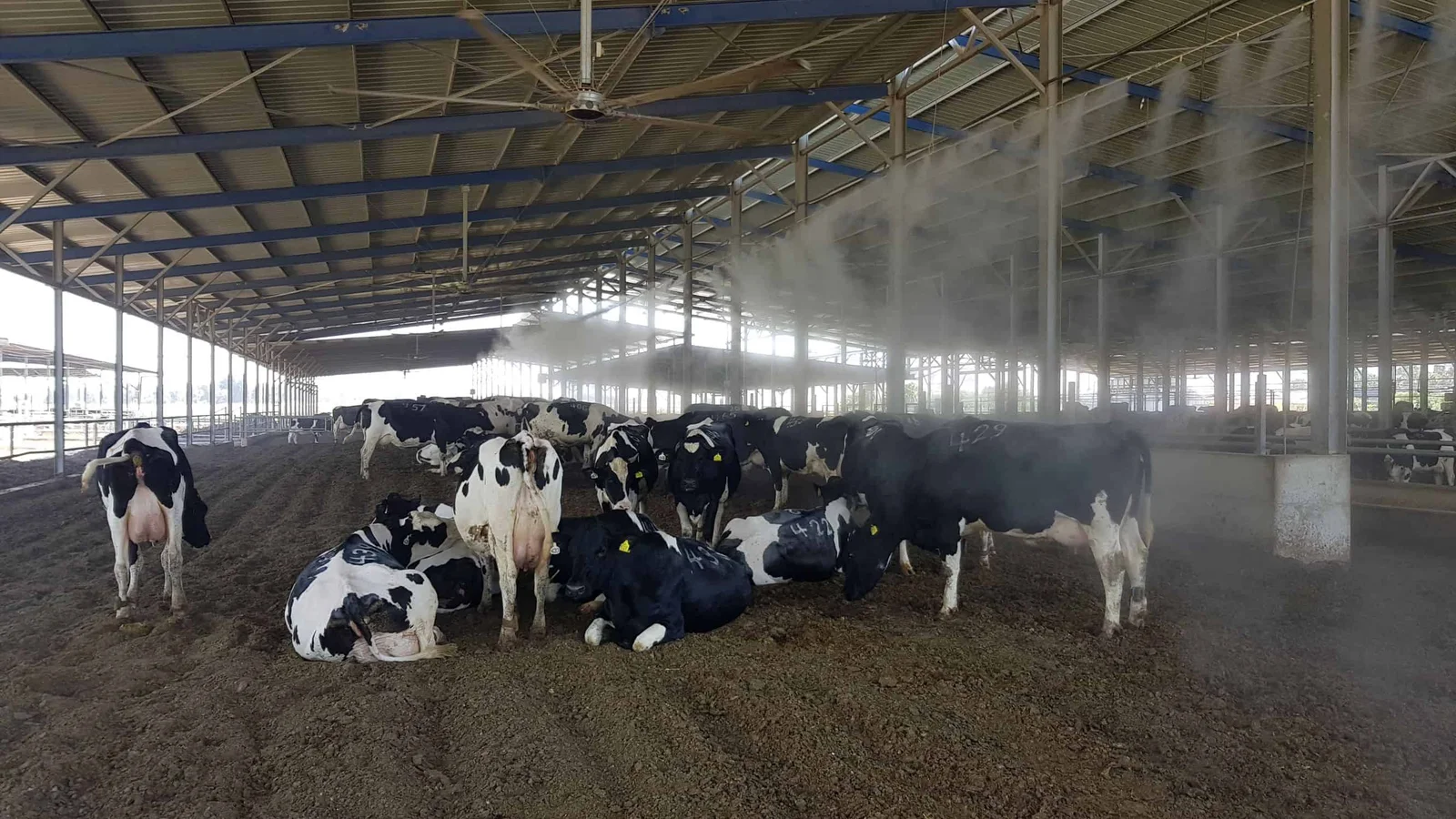
Start with what is actually scarce. In a desert barn it is not money and it is not equipment. Baladna produces around ten thousand cubic metres of recycled water a day for cooling, and reports a sixty percent cut in soaker water after moving to motion-activated jets. Al Rawabi in Dubai was described running eight hundred and fifty overhead fans and eighteen hundred cubic metres of water a day in summer against four hundred in winter. Cooling here is a large, metered, finite thing that has to be pointed somewhere.
So it gets pointed the obvious way. Milking cows first, because they are producing today. High-yielding pens ahead of low. Dry cows and heifers last, because they produce nothing today and the fans are needed elsewhere. That allocation is set once, in a policy, and then it runs all summer.
The animal earning nothing today is the one whose cooling decides next year.
the structural problem, in one lineBarn climate control runs on the temperature-humidity index, and the number nearly everything is set against is seventy-two. One widely used monitoring system alerts at exactly that. It comes from work on cows producing far less milk than the ones now standing in these barns.
For a modern high-yielding cow the line is lower. Tao and Dahl, reviewing the field in the Journal of Dairy Science, put it plainly: milk yield is negatively affected once average THI exceeds sixty-eight. A 2025 review in Animals gives the same number and names the population, cows producing above thirty-five kilograms a day. Baladna reported thirty-five point two litres in 2024; a commercial Saudi herd averaged fifty-six kilograms through a Gulf summer. These barns hold the cow the lower threshold was written for, and watch the higher one.
And the two largest losses never appear as litres at all.
The first is fertility. Wolfenson and Roth, working from an eighteen-year national dataset, record conception falling from about forty-three percent in winter to twenty-eight in summer. Their more important finding is what happens when cooling is good: milk holds at ninety-eight percent of the winter figure, and conception still only reaches sixty-eight. Cooling largely solves the milk problem and does not solve this one. There is also evidence that when you cool decides how much comes back. Flamenbaum and Galon report herds cooled intensively all season at fifty-nine percent conception against seventeen for uncooled, while cooling applied only around insemination gave no improvement at all.
The second is the dry cow. She is producing nothing, which is why she is last in the queue for fans. Tao and Dahl report that cows heat-stressed through late gestation give roughly four to five kilograms a day less milk in the following lactation. Fabris and colleagues measured 32.9 kilograms a day in early lactation for cows cooled through the whole dry period against 26.6 for those that were not, with the advantage still present thirty weeks in. Ferreira, Dahl and De Vries priced it at about four hundred and forty-eight kilograms a cow a lactation, and around eight hundred and ten million dollars a year across the United States.
None of that is visible in this summer’s tank. All of it is decided by who stood under a fan in August.
The dry-period effect is not settled at that magnitude. Rodríguez-Godina and colleagues found a difference of about two hundred and thirty-five kilograms across a 305-day lactation, roughly two percent, and no significant difference in total milk yield. The direction of the effect is well replicated. The size of it is not, and anyone selling against it should say so.
A cow sheds accumulated heat overnight, and that recovery window decides whether a hot day is survivable or cumulative. Across a thirty-year coastal record in Qatar, maximum temperatures rose about half a degree a decade while minimum temperatures rose about a full degree, and tropical nights increased by roughly thirty days. The nights are warming twice as fast as the days, and the nights were doing the repair work.
The dry period is about sixty days long and produces nothing. It sets mammary development for the next lactation, and the cooling decision taken during it is still showing in the milk thirty weeks later. The shortest window on the farm with the longest shadow, and the one the fans are pointed away from.
Conception in the hot months sets the calving pattern, and the production curve, twelve months out. In the eighteen-year dataset, summers only one and a half degrees above average cost a further five percentage points of conception. The bill for a hot August arrives the following winter, in a calving spread nobody connects back to it.
This is a well-equipped category. The animals are sensored, the barns are instrumented, and serious vendors sell heat-stress monitoring into exactly these operations. What none of them sells, on their own published wording, is a forecast. smaXtec offers to accurately detect heat stress and take immediate action
, alerting at a THI of seventy-two. Nedap detects four levels of heat stress
, updated in real time every 15 minutes
. Every one of those is a measurement of now.
And the schedule answers to something older than the weather. The Israeli Dairy School, teaching the wet-then-dry method that hot-climate confinement dairying is largely built on, explains the cadence without embarrassment: We milk our cows three times a day. So, we keep our cows cool by doing these three cooling cycles every day.
Cooling is applied in the waiting rooms before milking, wetting the cow with large droplets and then drying her under even airflow of about two metres a second.
That is a good method and it works. Note what sets the number. Three cycles, because there are three milkings, and because that is where the cows already are. The cadence comes from the parlour routine and the trigger from a threshold written for a smaller cow. Neither comes from what tomorrow will do.
Every dial in that method is adjustable, and none of them is adjusted by a forecast.
the rule, stated fairlyDroplet size, wetting time, airflow, the sequence of the two, how many cycles, how long each runs, and above all which pen is standing under it. A large decision space, already installed, already paid for, and set by habit.
This page depends on one question, so it is worth saying exactly where the evidence stops. Does changing the cooling policy, on hardware you already own, move fertility or next-lactation yield?
The literature splits into two bodies that never meet. One varies the policy: five cooling sessions a day against eight, a fixed run cycle against a presence trigger, a fixed schedule against an individualised one. Those hold the equipment constant, which is the right shape, and every one stops at respiration rate, body temperature, water use and same-lactation milk. The other measures fertility and next-lactation yield, and does it by comparing cooling against no cooling. That answers whether to own the equipment, not how to run it.
We ran about forty searches and read forty-five documents to establish that, including the full citing list of the closest paper, four recent reviews and two doctoral theses. The nearest single study, a randomised trial by Montevecchio and Chebel, pushed one allocation decision through to first-lactation fertility and found the allocation made things worse.
The field has the herds, the sensors and the barns to run this trial. It has not run it.
what forty searches establishedThere is a structural reason. Once cooling was shown to be incomplete on fertility, the response was to go around it, with embryo transfer and timed insemination, rather than back to the allocation question. That question was never the interesting one to a reproductive physiologist. It is the only interesting one to an operations manager with a finite volume of water.
In herds applying efficient cooling, summer milk is held very close to the winter level. Summer conception is not. The same cooling that rescues the tank leaves roughly a third of the fertility loss in place, and fertility sets next year’s production curve.
Both figures from Wolfenson & Roth (2019), Animal Frontiers 9(1):32–38, reporting an eighteen-year national dataset. The bars are drawn to those two published percentages and to nothing else.
Concentrated, capitalised, heavily instrumented herds in climates that run above the threshold for months. These are the figures the operators and the statistics agencies publish about themselves.
22,347 cows and 35.2 litres a cow a day in 2024, on two farms at Umm Al-Hawaya, with around ten thousand cubic metres of recycled water a day for cooling. Before the 2017 blockade, seventy-two percent of the country’s dairy supply was imported.
The statistics authority counted about 273,000 dairy cows in 2023 and 2.8 billion litres of raw milk. Almarai reported eight farms and over 189,000 cows producing 1.5 billion litres in 2025, all in enclosed housing. One national herd, effectively one operator.
A 51 / 49 joint venture between Baladna and the National Investment Fund: 3.5 billion US dollars, 117,000 hectares, 240,000 to 270,000 cattle at full capacity, 1.7 billion litres a year. In April 2026 Baladna announced 635 million dollars of second-phase contracts and an airlift of 30,000 Holsteins on 109 flights, with milk production stated for late 2027. The same company says it is accelerating discussions in further African markets.
Youran reported 621,568 dairy cows with 324,908 milkable at 12.6 tonnes each; Modern Dairy 456,945 head; Shengmu 156,481. USDA puts 70 to 80 percent of Chinese raw milk in large-scale farms. A national index study found most of the country above the danger threshold from June to September, with milk loss up to 140 kilograms a cow a month in Xinjiang.
April 2026: Texas 719,000 milk cows, New Mexico 237,000, Arizona 194,000, Florida 97,000, against California’s 1,715,000. A 2025 study across 18,000 herds put five-year losses at about 1.4 billion pounds of milk, roughly 245 million dollars, with yield loss on an extreme-heat day more than double a moderate one. Note the counter-example in the same data: Texas and Arizona out-produce California per cow. Heat does not decide output. Management does.
Forecast the heat load per pen, days ahead. Not the regional weather, which everyone has, but what the next four days do to each group given how they are housed, what they are producing, how far into gestation they are, and how the barn behaved last time conditions looked like this.
Optimise the allocation against what is finite. Cooling water, power and labour, across pens and stages, re-solved as the forecast moves. A constraint problem with a moving objective, which is the machinery this company was built on.
Score it against the outcome actually at stake. Not the tank this week. Next lactation’s yield from this summer’s dry pen, and next year’s calving pattern from this summer’s services.
None of that is speculative. Casarotto and colleagues took the soakers already installed on a commercial dairy and changed nothing but the control rule, replacing a fixed run cycle with a sensor that fires only when cows are there. Water use went from 184.6 litres a cow a day to 36.1, with no difference in milk yield. Same hardware, better rule, most of the resource back.
And the value is concentrated where it is hottest. Modelling across twenty-one Mediterranean locations found cooling recovering between 173 and 859 litres a cow a year, and no profit at all below a certain annual heat load.
The pilot is how you find out whether that is worth anything on your herd. It runs your own past hot seasons again, uses only the data that existed on each day, and scores the call it would have made against what actually happened.
We are not claiming more litres from a barn that already cools well. The closest published trial to what we do, by Levit and colleagues, ran individualised sensor-based cooling against a fixed schedule and cut heat-stress exposure from 9.46 hours a day to 5.03. Fat, protein and energy-corrected milk all improved. Daily raw milk yield was the same in both groups, at 44.7 kilograms. And Baladna’s own published yield gives no sign of a hot-climate penalty at all. If the value here is real it is in water and power per litre, in composition, and in the two things cooling currently fails to reach.
Nor is more cooling always better. The one randomised trial that follows an allocation decision through to fertility, by Montevecchio and Chebel, gave fans to pre-weaning calves and found the treated group had lower pregnancy rates in first lactation and were less likely to reach a second. Allocation decisions have consequences that are not obvious in advance. That is an argument for measuring them, not assuming them.
Short form. Every one of these is set out in full, with the figures we could not verify and the ones that cut against us, on Sources and notes.
Milk yield of lactating dairy cows is negatively affected by heat stress when average THI exceeds 68, and the four to five kilogram carry-over into the following lactation. doi.org
an acceptable THI limit for high-producing dairy cows (above 35 kg·day−1) is up to 68.doi.org
A pilot runs your own decisions again across hot seasons you have already lived, scored against what actually happened. You already know how those summers went. That is what makes it a test rather than a demonstration.